




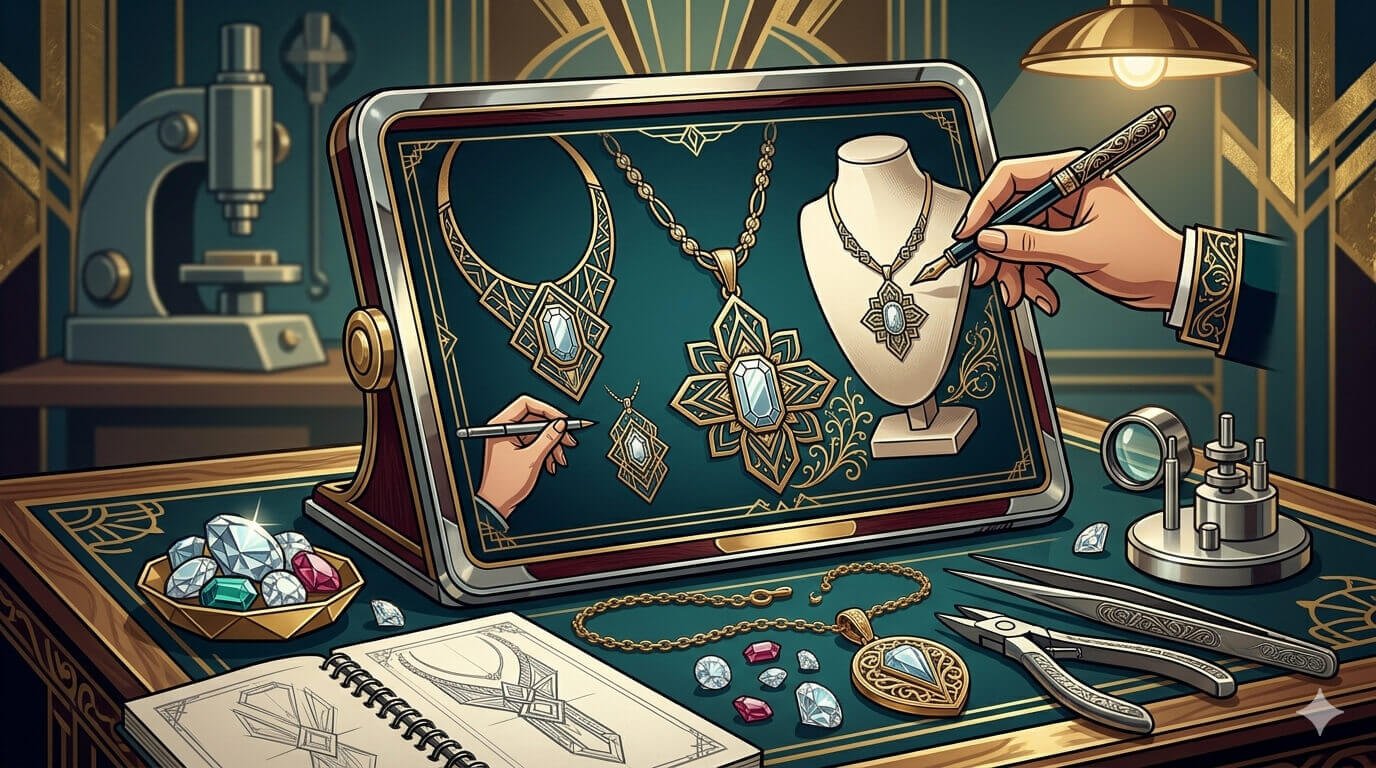
Creating custom cubic zirconia (CZ) jewelry is a fascinating blend of artistry, precision engineering, and traditional craftsmanship. Whether you’re an independent designer dreaming of a signature piece or a brand owner developing a new collection, understanding the typical process for creating custom CZ jewelry empowers you to make informed decisions and appreciate the skill behind each finished piece.
At CZDIA, we believe in democratizing access to premium jewelry materials and manufacturing knowledge. This guide walks you through the complete journey—from your first spark of an idea to the polished treasure in your hands.
Phase 1: Conceptualization and Design Brief
Every custom piece begins with an idea. This initial phase is where your vision takes shape through collaboration between you and the jewelry creator.
The Consultation
The process starts with an in-depth discussion to translate your emotions and abstract concepts into concrete design elements. Key decisions include:
-
Inspiration and Purpose: What is the piece for? An engagement ring, a fashion statement, or a brand signature piece? Bring inspiration photos, sketches, or descriptive words like “vintage,” “modern,” or “art deco.”
-
Stone Selection: Choose your CZ stone’s shape (round brilliant, oval, cushion, emerald, pear, princess, heart) and size (measured in millimeters). Plan the layout—a solitaire, a halo, three-stone setting, or a fully pavéd band.
-
Metal Choice: The base metal provides structure and color. Common options include sterling silver (925), various gold karats (10k, 14k, 18k) in yellow, white, or rose gold, and platinum for luxury pieces.
-
Design Details: Consider the ring’s profile, shank style, and embellishments like milgrain, engraving, or filigree.
Budget and Timeline
A professional designer will provide realistic guidance on how your choices impact cost and production time, ensuring expectations are managed from the start.
Phase 2: CAD Modeling – The Digital Blueprint
Once the conceptual design is approved, it enters the digital realm. This is a revolutionary step in the typical process for creating custom CZ jewelry.
Precision Engineering
A skilled CAD (Computer-Aided Design) technician creates a precise, three-dimensional model of your jewelry piece. The model is built to micron-level accuracy—every prong thickness, stone setting depth, and band curvature is mathematically defined.
Visualization and Iteration
You’ll receive photorealistic renderings of the CAD model from every angle. This eliminates guesswork and allows you to:
-
See exactly how light will play off surfaces
-
Verify stone arrangements
-
Request modifications (try a different stone shape, adjust band thickness, add a hidden halo)
Manufacturing Preparation
The CAD model isn’t just a picture—it’s a manufacturing guide. The designer ensures the model is optimized for the 3D printing and casting processes to avoid structural weaknesses. Your sign-off on the final CAD rendering authorizes physical production to begin.
Phase 3: Prototyping – From Virtual to Physical
The approved digital design must now take tangible form before committing to precious metal.
3D Printing (Rapid Prototyping)
The CAD file is sent to a high-resolution 3D printer that builds the jewelry piece layer by layer from liquid UV-sensitive resin. Technologies like Stereolithography (SLA) or Digital Light Processing (DLP) create precise resin prototypes.
This prototype allows you to:
-
Assess actual size, scale, and proportion
-
Check comfort and fit
-
Verify overall aesthetics before moving to metal
This “rapid prototyping” step serves as a final, low-cost insurance policy against design flaws.
For larger production runs, the manufacturer may create a rubber or metal mold from the prototype to produce multiple wax patterns.
Phase 4: The Lost-Wax Casting Process
This ancient technique, refined over millennia, is the primary method for transforming the design into metal. It’s a cornerstone of the typical process for creating custom CZ jewelry.
Creating the Wax Pattern
The approved prototype is attached to a wax “tree” with wax rods (sprues) that create channels for molten metal. The tree is placed in a flask and surrounded by liquid investment plaster slurry.
The “Lost-Wax” Burnout
The flask is heated in a kiln, which cures the investment into a hard mold and simultaneously “burns out” the wax or resin prototype—vaporizing it completely and leaving a perfect, hollow cavity in the shape of the jewelry piece.
Casting the Metal
The hot flask is immediately transferred to a casting machine. Molten metal (sterling silver, gold, or other alloys) is forced into the hollow mold by centrifugal force or vacuum. The metal fills every detail of the cavity, taking the exact shape of the original prototype.
Devesting and Cutting
After cooling, the flask is quenched in water, causing the brittle investment material to crack away. This reveals a “tree” of metal jewelry pieces, still attached to the central sprue. These rough castings are cut from the tree and ready for finishing.
Phase 5: Finishing and Stone Setting
The raw casting is far from finished. This stage transforms it into a refined piece of jewelry.
Initial Cleaning and Pre-Polishing
The piece undergoes tumbling—placed in a rotating drum with stainless steel shots and cleaning compound. This process work-hardens the metal, removes surface imperfections, and begins the polishing process. Any remaining sprue marks or major flaws are carefully filed away by hand.
The Crucial Step: Stone Setting
This is one of the most skilled and precise disciplines in jewelry making. A master setter takes over:
Preparing the Seat: Using a microscope and ultra-fine burs, the setter carefully cleans and cuts the exact seats for each CZ stone. The depth and angle must be perfect to ensure the stone sits flush and secure.
The Setting Process: Using specialized tools, the setter places each stone into its seat using various techniques:
-
Prong Setting: Small metal claws grip and secure the stone—most common for larger stones
-
Pavé Setting: Tiny beads of metal are raised from the surrounding surface and smoothed over stones’ edges for a “paved” effect
-
Bezel Setting: A strip of metal surrounds the stone’s girdle
-
Channel Setting: Stones are set in a row between two metal walls
The setter ensures every stone is perfectly level, secure, and oriented to maximize brilliance.
Final Polishing and Plating
After stones are set, the piece enters final polishing—on rotating wheels with increasingly fine abrasives to achieve a mirror-bright finish. This must be done meticulously to avoid damaging the already-set CZ stones.
If required, the piece now undergoes electroplating. Rhodium plating enhances whiteness and tarnish resistance for sterling silver or white gold pieces. Gold plating adds a warm tone to base metals.
Phase 6: Quality Assurance
Before the piece can be presented, it must pass rigorous inspection:
-
Visual Inspection: Every surface is checked under magnification for polishing marks, plating inconsistencies, or flaws
-
Structural Integrity: The piece is checked for strength and proper dimensions
-
Stone Security: Every CZ is verified for security, absence of chips, and correct alignment
-
Metal Purity: Silver purity is verified (e.g., 925 hallmark stamping)
-
Final Cleaning: A steam clean or ultrasonic bath removes dust and fingerprints
Phase 7: Packaging and Delivery
Once approved, the jewelry is carefully packaged to prevent damage during transit. Custom packaging options may be available to align with branding or personal preferences.
Bottom Line
The typical process for creating custom CZ jewelry is a journey that transforms a personal vision into a tangible treasure. From the initial consultation and precise CAD modeling to the ancient art of lost-wax casting and meticulous stone setting by master artisans, each step requires skill, patience, and attention to detail.
At CZDIA, we understand the importance of quality at every stage. Whether you’re designing a single custom ring or developing a wholesale collection, we’re committed to democratizing access to premium 5A+ cubic zirconia and the manufacturing knowledge you need. The power to create beautiful, custom jewelry is in your hands—and understanding the process is the first step to making that power your own.
 English
  العربية
  Nederlands
  Français
  Deutsch
  Ελληνικά
  Bahasa Indonesia
  Italiano
  日本語
日本語  Português do Brasil
  Português
  Русский
  Español de México
  Español
  Українська
  Tiếng Việt